
About CMU
Introduction
Mission Statement
Story of CMU
Statements of Faith
CMU Founding Colleges
About AUCC
History of Founders Hall
Supporting Churches
Mennonites
Faculty & Staff
Employment
Volunteering
about cmu - founders hall

If Walls Could Talk: The Human Story of 500 Shaftesbury Blvd.

By Brenda Suderman

If the walls at CMU’s Founders Hall could talk, what would they say?

They would probably tell stories of young love, of finding a place to belong, or the joy of sharpening debating skills during late night political skirmishes. They’d reveal grumblings of young airmen disgusted with the mess hall offerings, and maybe even a few classified military secrets.

CMU East TowerThey’d likely also recount stories of courage—deaf high school graduates ready to face the world with marketable skills, newly minted teachers setting out to inspire young minds of Manitoba, families struggling to find economic footing, or young men flying off to face an enemy overseas.

If the walls at 500 Shaftesbury Boulevard could talk, those are some of the stories they might tell after eight decades as a place of learning—and a home—to tens of thousands of students.

“You talk to some deaf people who said they weren’t born until they came here because they didn’t have any language,” says Howard Miller, the former principal of the Manitoba School for the Deaf, which occupied the campus for half a century.

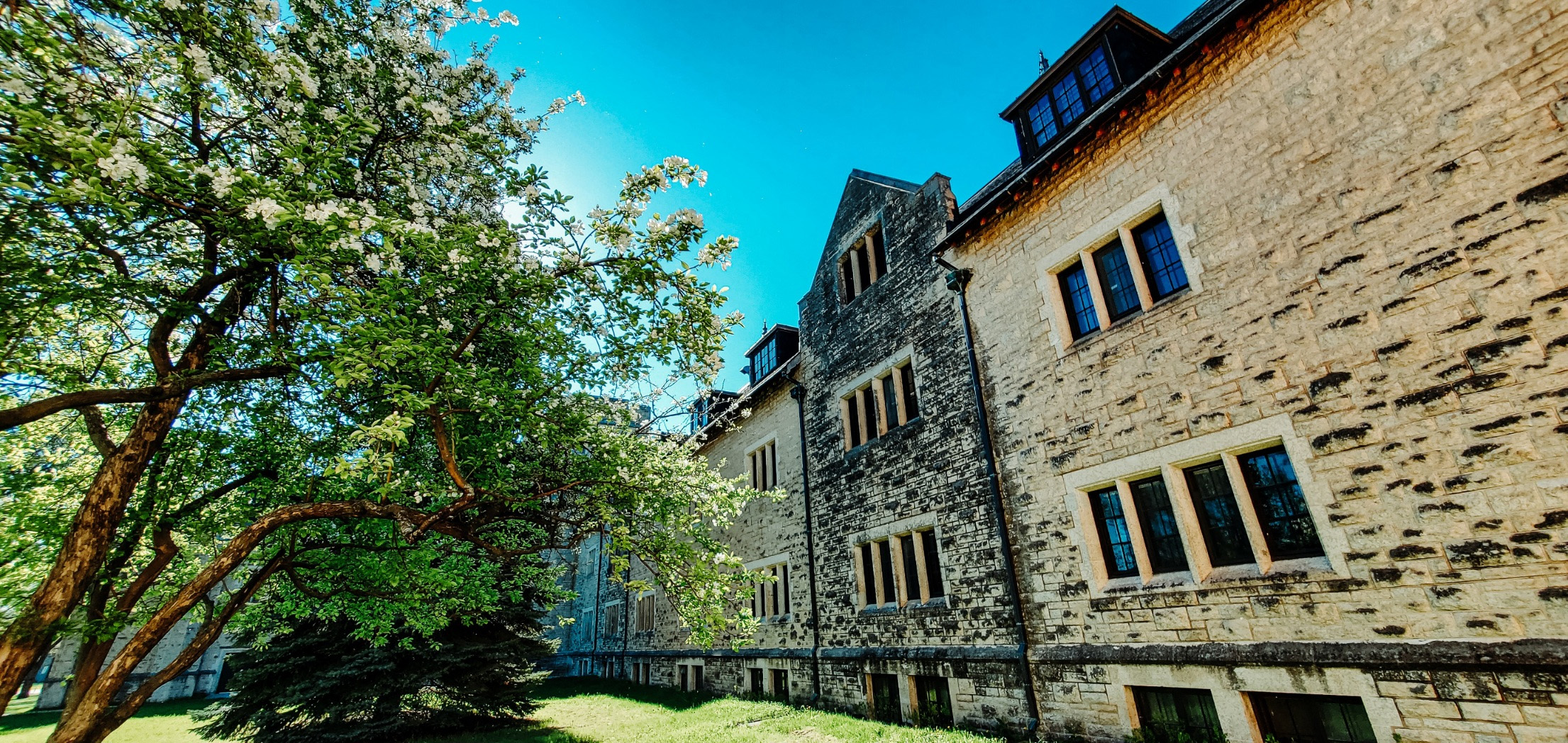
Constructed in 1921-22 by the provincial government as a custom-built campus for the Manitoba School for the Deaf, which had been operating out of temporary quarters at the nearby former Manitoba Agricultural College, this grand lady of Shaftesbury featured limestone walls, Tudor arches, cove ceilings, gargoyles, spires, and a four-storey tower at the main entrance.

“We are convinced, however, that we have one of the best school buildings to be found anywhere and we are going to be able to do good work here,” states the Nov. 12, 1922 front-page editorial of The Echo, the school’s newsletter.

Designed by American architect John D. Atchinson, the English Collegiate style campus boasted a main instruction building with 16 small south-facing classrooms, a large auditorium, and vocational instruction in home economics, printing, and carpentry. Girls lived on the third and fourth floors of the north-south (C) wing, boys on the third floor of the classroom (B) wing, with the dorms separated by a solid brick wall. Electrical shaker units were attached to each bed to wake students in case of fire, and each dormitory was equipped with emergency strobe lighting.

Founder's Hall, north side Founders Hall, 1920s,
view from north
Founder's Hall, south side Founders Hall, 1920s,
south side.

The dining hall had separate entrances for boys and girls at the south and north. What is now a daycare centre was the basement play area, and the third level of McDermid tower, named after the school’s superintendent who drowned during construction, was a lounge for the boys’ dorm.

Two short decades later, the live-in deaf and hard of hearing students were moved to Saskatoon or Montreal to make room for the war effort. For the next five years, thousands of new recruits to the Royal Canadian Air Force studied radio communications at the new No. 3 Wireless School on Shaftesbury Blvd. Six H-huts (two dormitory buildings linked by a washroom, forming the letter H) were constructed to the west of the dining hall, and a large hangar-style gymnasium could easily accommodate two basketball courts. Young airmen from across Canada and the Commonwealth lived and studied at No. 3 Wireless for an intensive 28 weeks, committing the Morse code to memory in order to be able to transmit and receive messages at a speed of 35 words per minute.

Great Hall“We had to learn quite a lot about the mechanical end of what a transmitter did and what a receiver did,” recalls Allan MacKay of Brandon, MB, who spent the winter of 1941-42 at No. 3 Wireless. To practice their communication skills, students would climb the narrow wooden staircase to the fourth floor tower room to make radio contact with RCAF planes flying past from the Stevenson Airfield, now Winnipeg International Airport.

Although their task was serious, MacKay remembers fun times as well, including more than a few wartime romances, and soldiers maneuvering around strict military curfews.

”We used to line up with some of the guards who were marching through and went in with them during the changing of the guard,” chuckles the former car dealer of their late night exploits. A year or so after he left Winnipeg, MacKay encountered a friend who reported the airmen had gone on strike at No. 3 Wireless because the food was so terrible.

After the war, the campus went through another incarnation, this time welcoming young adults from across Manitoba as they trained to be teachers at the Manitoba Provincial Normal School, later Manitoba Teachers’ College. Four hundred or so would-be teachers spent a year studying educational theory and practices, with most living on campus in the military barracks or the main building dorms. With activities like choirs, drama, and sports and dances in the military-era canteen claiming evenings, sometimes rules about dorm life were hard to follow, recalls one student.

“It was very profitable to become friends with the (steam) engineers so nobody would say ‘OK, yes five girls were late,’ ” explains 1954 grad Stephanie Toronowsky about midnight trips past the basement boiler room and through the tunnel connecting the main building with the dining hall.

Just like university students of today, students of 50 years ago loved to engage in political debate, recalls former Manitoba Premier Howard Pauley, also of the class of 1954.

“It was quite a raucous group. We had lots of debates here, always about politics, quite diverse points of view,” says the former house captain of Frontenac Hall, the men’s’ dorm, located on the second and third floors of what is now the music wing.

Students also complained about the state of the facilities, with one aspiring student president campaigning on a platform of building showers in the dormitory. He wasn’t elected, the showers never materialized, and students were stuck with taking baths.

Meanwhile, the barracks at No. 3 Wireless were converted into emergency housing for low-income Winnipeggers after the war. About four dozen families resided in apartments carved from the H-huts, sharing common washrooms and laundry facilities in the connecting corridor. Children up to grade four attended a small “model” school staffed by the student teachers, says Ken Franklin, whose family of 11 lived on campus from about 1949 until the mid-1950s.

mist“I have very, very pleasant memories of growing up there and intermingling with the (Normal School) students,” recalls Franklin, now a structural engineer in Winnipeg. “There was so much adventure out there, playing in the forests.”

By 1965, teacher education was transferred to the University of Manitoba campus, and the building reverted to its original use as a School for the Deaf, this time drawing students only from Manitoba. The student population hovered around 90 students, with live-in students only numbering 20 or less by the mid-80s.

Considered modern in 1922, the long hallways, multiple levels and sprawling campus became unworkable for a smallish school. A 1984 renovation added a new gym to the south, additional staircases for fire exits and the above ground link, but issues of wheelchair accessibility still remained.

“This is a beautiful building and the Deaf people love it and the Deaf community regrets losing the building,” says Miller of the mixed feelings accompanying a late 1996 move to a smaller, more accessible newly constructed building in west Winnipeg.

After a brief period as the administrative centre for the 1999 Pan American Games, a century-old dream to establish a university in southwest Winnipeg was finally realized when Canadian Mennonite University purchased the campus in 2000. Extensive renovations transformed dormitory rooms into offices, small classrooms into lounges and seminar rooms, and vocational areas into instructional spaces to accommodate students who now study at CMU.

Designated as a provincial heritage site in 2000, what is now known as Founders Hall at CMU provides an architectural link to the importance past generations placed on formal education, says architect Rudy P. Friesen, a member of the architects’ consortium which prepared the design for the renovations. He hopes current CMU students will see this grand lady of Shaftesbury as more than just a place to study, but also as a link to the past.

“I would hope this would teach them something about tradition,” Friesen says of stately building. ”There is a tradition or history that goes back some time. Not everything is built yesterday.”

The sense that something special and significant is happening here has lingered through the decades. Imposing and welcoming at the same time, this grand old lady of Shaftesbury regularly attracts alumni from its various incarnations, with recent visitors including a television documentary team from New Zealand interested in telling the story of Commonwealth pilots who had trained there. This connection between the past and the present is one the people of CMU nurture and value, explains David Leis, vice-president for advancement.

“Everyone who has contact with the building has a deep respect for the sense of community and its place in the community.”